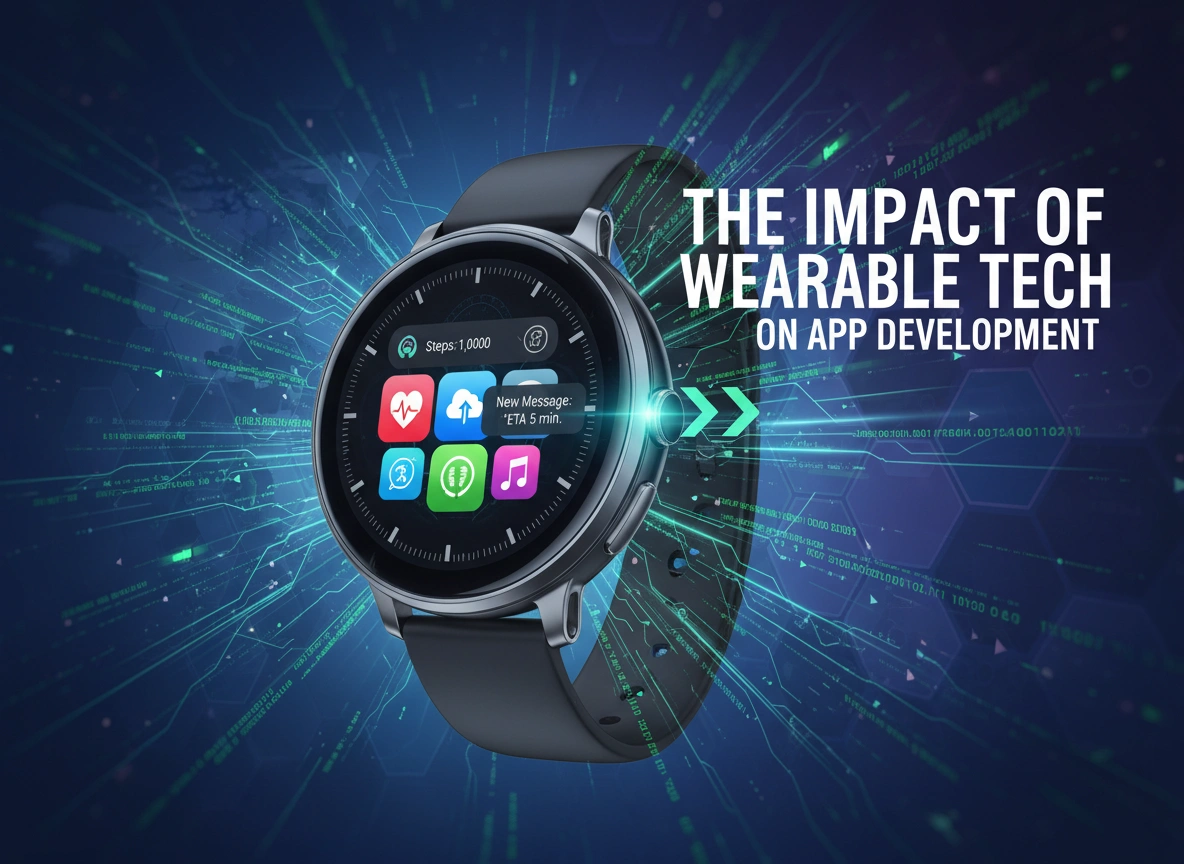
The way we interact with technology is no longer confined to the screens in our pockets or on our desks. It has moved to our wrists, our eyes, and even our clothing. Wearable technology has surged from a niche novelty into a mainstream powerhouse, fundamentally altering the landscape of mobile applications. For developers, this shift isn’t just about shrinking a smartphone interface onto a smaller screen; it requires a complete rethinking of user experience, functionality, and connectivity.
The Rise of the Connected Self
Smartwatches, fitness trackers, and AR glasses are becoming ubiquitous. This explosion in hardware adoption has created a massive demand for software that powers these devices. The “connected self” is no longer a futuristic concept but a daily reality for millions.
This shift has forced the app development industry to evolve rapidly. Developers are now tasked with creating ecosystems rather than standalone applications. An app on your phone must talk seamlessly to the watch on your wrist, syncing health data, notifications, and media controls in real-time. This interconnectedness is the new standard, and it is reshaping how apps are built from the ground up.
Redefining User Interface (UI) and User Experience (UX)
The most immediate impact of wearable tech on app development is the constraint of physical space. Designing for a 40mm watch face is vastly different from designing for a 6-inch phone screen or a 15-inch laptop. This limitation has birthed a new era of minimalism in UI/UX design.
The “Glanceability” Factor
In traditional mobile app development, engagement is often measured by session length—how long a user stays in the app. With wearables, the opposite is true. Success is defined by brevity. Developers now prioritize “glanceability”—the ability for a user to get the information they need in two seconds or less.
Designers must strip away non-essential elements. Complex navigation menus are replaced by simple swipes or voice commands. High-density text is replaced by bold icons and haptic feedback. The challenge lies in maintaining functionality without clutter. If a user has to squint or scroll excessively on their wrist, the UX has failed.
Context-Aware Computing
Wearables have elevated the importance of context. Because these devices are worn on the body, they have access to immediate physiological and environmental data that a phone in a pocket might miss. Successful wearable apps leverage this.
For example, a running app on a smartwatch doesn’t just track GPS; it monitors heart rate zones and adjusts audio feedback accordingly. A meditation app might detect rising stress levels through biometric sensors and prompt the user to breathe. Developers are now building apps that don’t just wait for input but proactively respond to the user’s physical state.
Technical Challenges and Architecture Shifts
Behind the sleek interfaces lie significant technical hurdles. Building for wearables introduces constraints regarding battery life, processing power, and connectivity that are far more severe than in smartphone development.
Battery Efficiency is King
On a smartphone, a poorly optimized background process might drain 5% of the battery, which is annoying but manageable. On a smartwatch with a tiny battery cell, that same process could kill the device by midday.
Developers must write hyper-efficient code. Data polling must be infrequent or pushed only when necessary. Dark modes and OLED-friendly color palettes are not just aesthetic choices but essential power-saving strategies. This focus on efficiency often leads to better coding practices that benefit the main smartphone applications as well.
Data Synchronization and Latency
Most wearable apps still act as extensions of a primary smartphone app (tethered apps), although standalone apps are growing. This relationship requires robust data synchronization. Ensuring that a notification dismissed on a watch also disappears from the phone instantly requires low-latency communication protocols.
Bluetooth Low Energy (BLE) has become the standard for this communication, but implementing it correctly is tricky. Developers must handle connection drops gracefully. If a runner leaves their phone at home, the watch app must cache data locally and sync it seamlessly once the connection is re-established without data corruption.
New Opportunities in Specific Verticals
While general productivity apps have a place on wearables, specific industries have seen transformative growth due to these devices.
Health and Fitness Revolution
This is the most obvious beneficiary. Wearables have turned app development into a tool for preventative healthcare. Apps like Strava, Apple Health, and Fitbit don’t just record data; they gamify fitness and provide medical-grade insights.
Developers are now integrating APIs that allow apps to detect falls, monitor blood oxygen levels, and even take ECGs. This has opened a new sector of “MedTech” app development, where software must meet rigorous privacy standards (like HIPAA in the US) while remaining user-friendly.
Augmented Reality (AR) and Enterprise
While smartwatches dominate the consumer space, smart glasses and AR headsets are making waves in enterprise app development. Field technicians use AR apps to see schematics overlaid on physical machinery. Surgeons use them to visualize patient data without looking away from the operating table.
Developing for these platforms requires mastering 3D environments and spatial computing. It is a leap from 2D screen design to 3D interaction design, requiring skills more akin to game development than traditional app building.
Case Studies: Success in Wearable Integration
Looking at successful implementations helps visualize these principles in action.
Spotify
Spotify’s wearable integration is a masterclass in context and control. On a smartwatch, it doesn’t try to be the full app. It focuses on what a user needs while their phone is in their pocket: playback control, volume adjustment, and library selection. It recently introduced offline downloads for watches, recognizing that runners often want music without carrying a phone. This feature alone drove massive user engagement.
Calm
The meditation app Calm utilizes the Apple Watch to guide breathing exercises. It uses the Taptic Engine (haptic feedback) to tap the user on the wrist to signal when to inhale and exhale. This allows the user to close their eyes and focus entirely on the physical sensation, creating a user experience that is impossible to replicate on a phone alone.
The Future: Standalone and Invisible
The trajectory of wearable tech points toward independence. With the advent of eSIM technology, smartwatches are increasingly becoming standalone devices that do not require a nearby phone. This shifts the development paradigm again. Apps will need to be fully functional native applications, not just remote controls for a phone.
Furthermore, “invisible” wearables like smart rings (e.g., Oura Ring) or smart clothing are gaining traction. These devices have no screens at all. App development for these platforms is entirely data-driven. The “interface” is the post-activity analysis on the phone, meaning the app must excel at data visualization and storytelling to make the collected metrics meaningful to the user.
Conclusion
Wearable technology has done more than just add a new screen size for developers to worry about; it has fundamentally changed the philosophy of app development. It has shifted the focus from immersion to interaction, from session length to glanceability, and from manual input to context-aware automation.
For developers, the message is clear: the future is not just mobile; it is wearable. To stay relevant, development teams must master the art of efficiency, prioritize context over clutter, and build ecosystems that flow seamlessly across the user’s digital and physical life. As hardware becomes more sophisticated and sensors more accurate, the apps that succeed will be the ones that feel less like software and more like a natural extension of the user themselves.
Please visit this website for more info.
