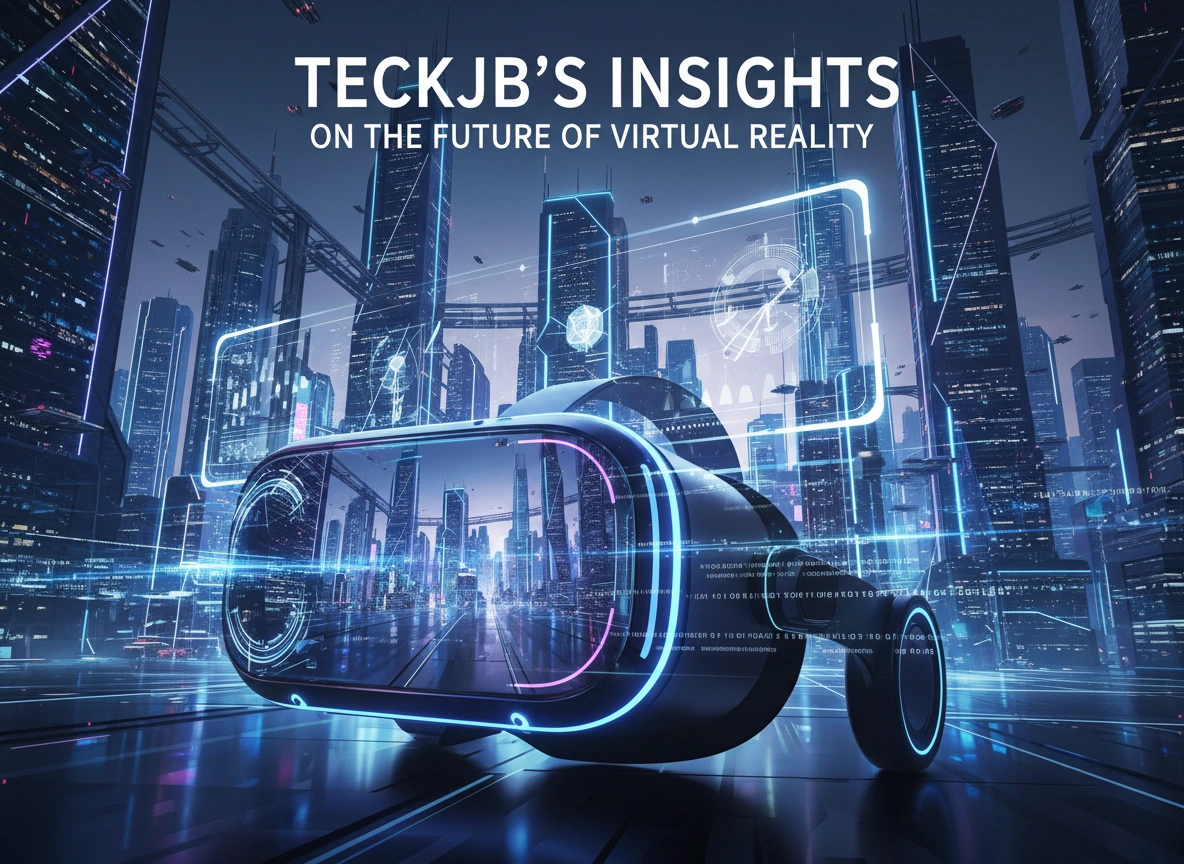
Virtual reality (VR) is no longer a concept confined to science fiction movies or high-end research labs. It has arrived on our doorsteps, in our classrooms, and inside our operating theaters. While many still associate VR primarily with gaming, the horizon of this technology stretches far beyond entertainment. At Teckjb, we believe we are standing on the precipice of a significant digital evolution, one where VR transforms from a novelty into an essential utility.
This deep dive explores the current landscape of virtual reality, its expanding role across critical industries, the hurdles hindering mass adoption, and our predictions for what the next decade holds for immersive technology.
The Current State of Virtual Reality Technology
To understand where we are going, we must first appreciate where we stand. The current state of VR is defined by rapid hardware iteration and a software ecosystem that is finally catching up to the technology’s promise.
We have moved past the era of clunky, tethered headsets that require thousands of dollars in computing power to run effectively. The market is now dominated by standalone devices that offer “six degrees of freedom” (6DoF) without a single wire. This shift towards portability has been crucial. It has democratized access, allowing users to experience high-fidelity virtual environments without needing a dedicated room or a high-end PC.
However, we are still in what could be called the “early adopter” phase of mass market penetration. The hardware is impressive, boasting higher resolutions and better field-of-view (FOV) than ever before, but it hasn’t yet reached the ubiquity of the smartphone. At Teckjb, we see this current phase as the foundation-building era. Developers are learning the language of spatial computing, figuring out what interactions feel natural and what causes motion sickness, setting the stage for the next leap forward.
Beyond Gaming: VR Applications in Key Industries
While gaming remains the most visible face of VR, the technology’s true power lies in its ability to simulate reality for training, empathy, and visualization.
Revolutionizing Healthcare
The healthcare sector is arguably where VR is making its most profound impact. Surgeons are now using VR simulations to practice complex procedures before ever making an incision. This “surgical rehearsal” reduces error rates and shortens operation times.
Beyond training, VR is being used for pain management. Studies have shown that immersing burn victims in snowy, virtual environments during wound care can significantly reduce their perception of pain. At Teckjb, we are particularly excited about VR’s application in mental health therapy, where controlled environments are used to treat PTSD and phobias through exposure therapy.
Transforming Education and Training
The traditional classroom model is static; VR makes learning dynamic. Instead of reading about the Roman Empire, students can stand in a digital reconstruction of the Forum. Complex scientific concepts, like molecular structures or astronomical distances, become tangible when you can manipulate them in 3D space.
In the corporate world, VR is reshaping vocational training. From flight simulators for pilots to safety drills for oil rig workers, VR allows employees to gain muscle memory and experience dangerous scenarios without any physical risk. This “learning by doing” approach boasts significantly higher retention rates compared to traditional lectures.
Reshaping Real Estate and Architecture
Buying a home or designing a building is inherently spatial, yet we have relied on 2D blueprints and photos for decades. VR changes this equation entirely. Real estate agents can now offer virtual tours of properties to buyers on the other side of the globe.
Architects and construction firms use VR to walk clients through a building before the foundation is even poured. This allows stakeholders to spot design flaws, check sightlines, and experience the flow of a space, saving immense amounts of time and money on revisions during the construction phase.
The Challenges Facing Mass Adoption
Despite the optimism, the road to a VR-saturated future is paved with significant obstacles. Teckjb identifies three primary challenges that the industry must overcome.
1. Cost and Accessibility
While prices have dropped, a high-quality VR experience is still a luxury for many. When you factor in the cost of the headset, potential subscription fees for software, and the need for high-speed internet for cloud streaming, the barrier to entry remains high. For VR to become truly ubiquitous, the price point needs to align closer to that of a standard gaming console or a mid-range smartphone.
2. Technical Limitations and Form Factor
Current headsets are still relatively heavy and can become uncomfortable after prolonged use. Issues like battery life on standalone units limit the duration of sessions. Furthermore, the “screen door effect” (where the gap between pixels is visible) has been reduced but not entirely eliminated in consumer-grade models. Until a headset feels as lightweight and unobtrusive as a pair of sunglasses, friction will always exist for the average user.
3. Motion Sickness and User Comfort
The disconnect between what your eyes see (movement) and what your inner ear feels (stillness) causes motion sickness for a significant portion of the population. While software tricks like teleportation movement and higher refresh rates help, this physiological hurdle prevents many people from engaging with VR for more than a few minutes at a time. Solving this biological conflict is one of the toughest engineering challenges in the field.
Predictions for the Future: A Teckjb Perspective
Looking ahead, we see a convergence of technologies that will propel VR into its next generation.
Integration with Artificial Intelligence
The future of VR is inextricably linked with AI. We predict that AI will drive dynamic content generation, creating virtual worlds that react and evolve in real-time based on user behavior. Imagine a training simulation where the virtual characters don’t follow a script but react intelligently to your words and actions using advanced Large Language Models (LLMs). This will make virtual experiences feel infinitely more organic and responsive.
The Rise of Mixed Reality (MR)
Pure Virtual Reality isolates you from the world; Augmented Reality (AR) overlays data onto it. The future lies in the middle: Mixed Reality. We expect the dominant hardware of the future to be passthrough devices that can seamlessly switch between full immersion (VR) and digital overlay (AR). This flexibility means a single device can be used for deep work, immersive gaming, and practical navigation assistance, increasing the utility of the hardware tenfold.
Haptic Feedback and Sensory Immersion
Visuals and audio in VR are already excellent. The next frontier is touch. We anticipate major advancements in haptic technology—gloves, vests, and even suits—that allow users to “feel” the virtual world. Feeling the resistance of a virtual object or the texture of a digital surface will be the catalyst that tricks the brain into achieving full presence.
Broader Social Adoption via the “Metaverse”
While the buzzword “Metaverse” has seen fluctuating popularity, the core concept of a persistent, social 3D internet remains valid. As internet speeds increase (thanks to 5G and eventually 6G), we predict VR will become the preferred medium for social interaction over long distances. Instead of a Zoom call, you will sit in a virtual conference room with colleagues, seeing their avatars gesture and interact as if they were physically present.
Conclusion
The journey of virtual reality is just beginning. We have moved past the gimmick phase and are now deep in the utility phase, discovering where this technology adds real value to human life.
Challenges regarding comfort and cost are real, but they are engineering problems, not fundamental flaws in the concept. As processing power increases and components shrink, the hardware will vanish, leaving only the experience.
At Teckjb, we see a future where VR is a tool as common as the laptop—a window into worlds we could never visit and a classroom for skills we have yet to master. The question isn’t whether VR will succeed, but how quickly we can build the ethical and technical framework to support it.
Next Steps for Enthusiasts and Businesses
If you are looking to stay ahead of this curve:
- For Businesses: Audit your current training and design processes. Ask yourself where 3D visualization or immersive simulation could save money or improve safety.
- For Consumers: Try the latest generation of standalone headsets. The leap in quality from just three years ago is substantial.
- For Developers: Start exploring engines like Unity or Unreal Engine 5. The demand for creators who understand spatial computing is about to skyrocket.
The future is virtual, and it is closer than you think.
Please click here for more info.
